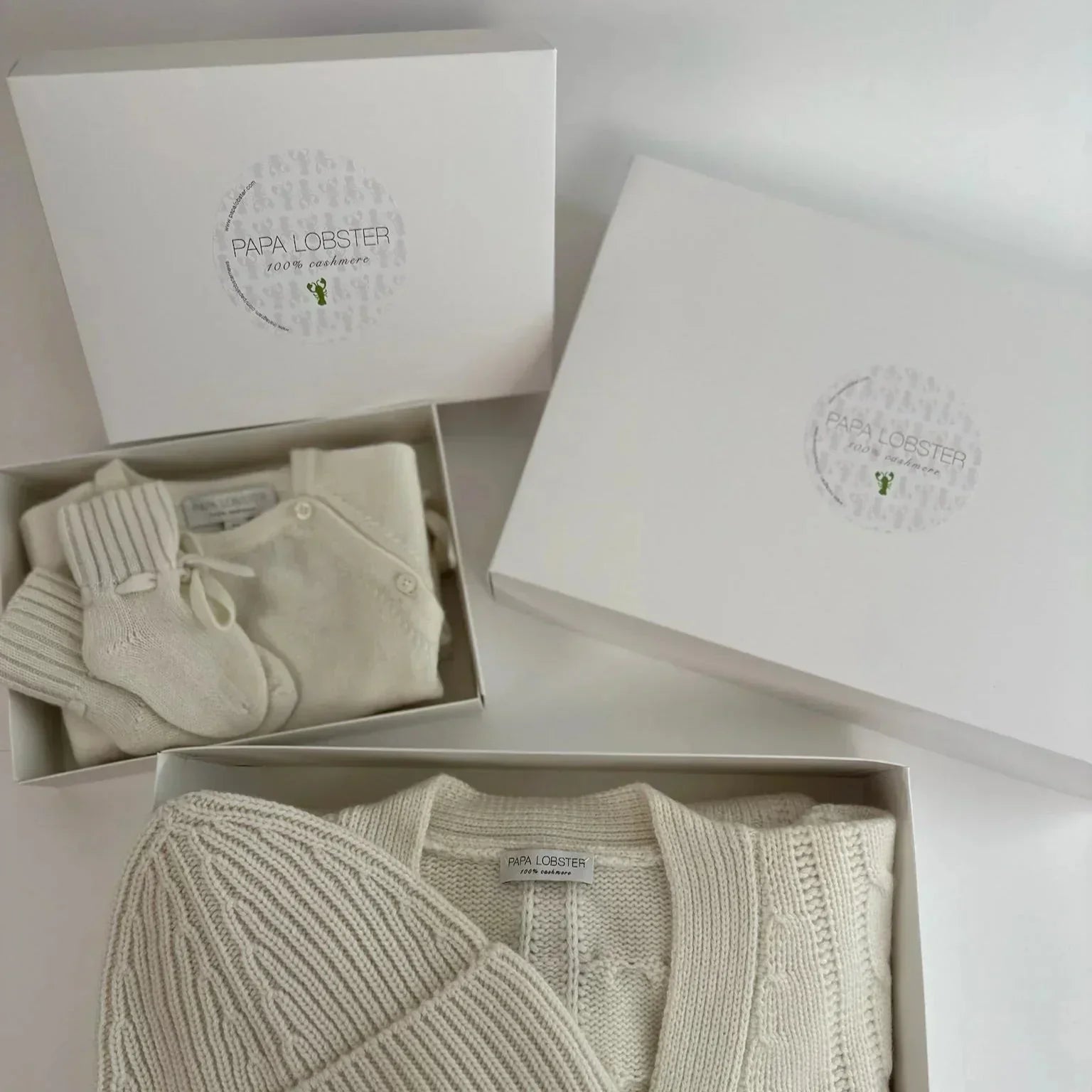

Sun, ice cream, and long walks—wonderful! And yet, every year, that little bit of summer panic creeps up on parents all over again: Too hot? Too cold? Will they catch a cold? We’ll tell you how to dress your baby properly in the summer—and which material outshines all the rest.
Short answer:In thesummer, your baby should ideally wear one more layer than you do—but made of the right material. Cashmere actively regulates body heat, keeps your baby’s skin dry, and cushions the temperature shock when moving into air-conditioned rooms. Cotton sounds logical, but it’s a trap: it absorbs sweat, dries slowly, and cools your baby’s skin down.
The Golden Rules ☀️
Neck Check: Forget the forehead. Forget the hands. The most reliable way to check your baby’s temperature is at thenape of the neck, right at the hairline. This gives you the right answer right away:
- Warm and dry→perfect
- Sweaty or sticky→one less layer
- Cool→one more layer
The forehead and hands aren’t good indicators—they cool down faster and give a distorted picture. Especially at night, many parents unconsciously reach for their baby’s face and end up tucking them in too warmly.
Shade first: Direct midday sun (11 a.m.–3 p.m.) is a no-go for a baby’s skin, no matter how old the child is. Babies have very little melanin in their skin and burn quickly, even on cloudy days, since up to 80% of UV radiation penetrates the clouds.
Head protection: A lightweight sun hat with neck protection is a must for every outing. Always.
The Big Material Trap

Cotton seems like the obvious choice—natural, soft, and often more affordable. The problem lies in the physics of the fiber.
Cotton is hydrophilic: it readily absorbs moisture, up to 65% of its own weight. That sounds good, but it’s actually the problem. The fiber releases moisture very slowly. Depending on the fabric’s thickness,it takes30 to 90 minutes for a sweat-soaked cotton onesie to dry. During this time, your baby is lying in damp clothing directly against their skin.
If there’s then a draft, a breeze, or—the most common trigger—an air-conditioned room, the moisture suddenly cools the skin. This is the mechanism behind the classic summer cold in babies.
Linendriesa bit faster, but it cools the skin just as quickly in a draft and is too rough for sensitive newborn skin.Syntheticsaren’tan option anyway—they barely breathe and trap heat.
The summer hero nobody knows about: cashmere ☁️
Yes, really. Baby clothes made of 100% cashmere in the summer sounds crazy—but it’s science. Cashmere comes from the cashmere goat, which lives in Central Asia—regions with temperatures ranging from−30 °C in winter to +40 °C in summer. The fiber has evolved to be optimized for precisely these temperature fluctuations. The result is a material that actively regulates temperature rather than passively insulating.
Cashmere can absorb up to 30% of its own weight in moisture and quickly releases it again. This keeps baby’s skin dry even at 30 °C—without the cooling shock of cotton.
What this means in practice:
- Moisture Absorption:Cashmereabsorbs up to 30% of its own weight in moisture—without feelingdamp.¹Themoisture is transported into the fiber and quickly released to the outside, rather than being trapped against the skin.
- Thermoregulation:Thecashmere fiber has a natural hollow structure that acts as a buffer between body heat and the outside temperature—cooling in the heat, insulating in the cold.
- No itching:Cashmere fibershave a diameter of only14–19 microns(compared to 20–36 microns for regular sheep’s wool). Below 19 microns, the fibers bend away instead of pricking the skin—which is why cashmere doesn’t itch, not even on ultra-sensitive newborn skin.
The climate trap: 32 °C outside, 21 °C inside 🚗❄️
The underestimated risk of catching a cold in the summer isn’t the heat. It’s theabrupt change. Supermarkets, restaurants, cars: Most air-conditioned spaces in Germany are cooled down to 19–22 °C. That’s a temperature drop of 10 to 15 degrees—in seconds.
Adults compensate for this with their circulation and muscle mass. Babies don’t. Their body surface area-to-body mass ratio is significantly higher than that of adults, which means they lose body heat faster and are more sensitive to temperature changes.
The solution is simple: anultralight cashmere cardigan in your backpack. It weighs barely 80–100 grams, can be slipped on in seconds, and completely compensates for the temperature change.
Our insider tip for the stroller: Acashmere baby blanketlooselydraped over the legs serves as both UV protection and a barrier against drafts—without trapping heat underneath. This doesn’t work with cotton blankets: They heat up in the sun and trap heat.
Baby Temperature Guide: What Should I Dress My Baby in and When? 🌡️
| Outside Temperature | During the day | In the stroller | At night (room) |
|---|---|---|---|
| Below 20 °C | Bodysuit + onesie + cashmere jacket | + cashmere blanket | Long-sleeved bodysuit + onesie + blanket |
| 20–24 °C | Short-sleeve bodysuit + thin onesie | + Cashmere blanket over legs | Short-sleeve onesie + thin romper |
| 25–28 °C | Short-sleeved onesie or romper | Cashmere blanket to protect against drafts | Short-sleeve onesie + cashmere blanket |
| Over 28 °C | A bodysuit alone is enough | Cashmere blanket for UV protection | Bodysuit alone, blanket within reach |
Applies to babies 3 months and older. Newborns generally need one more layer—see below.
What should you dress a newborn in during the summer? 👶
Newborns up to about 3 months of age cannot regulate their body temperature on their own—the hypothalamus, which controls thermoregulation, is not yet fully developed. This makes them particularly vulnerable tobothextremes: overheating and getting too cold.
The rule of thumb for the first few weeks:one more layer than you’re wearing yourself. And it really does apply—not just as a vague guideline, but because newborns lose body heat proportionally much faster.
Practical tip: At 25–28 °C, a thin short-sleeved onesie plus a light cashmere blanket loosely draped over it is plenty. At temperatures above 28 °C, even a newborn in just a onesie will hardly sweat—but keep a blanket handy anyway. Alwayscheck the fontanelle and the back of the neck : They react faster than the forehead or hands.
What should you dress your baby in at night? 🌙

Less is more—but going naked isn’t an option. Babies lose measurable body heat between 2 and 5 a.m., even on warm summer nights. Cotton clothing is particularly tricky at night: it absorbs night sweat and cools down at the first breeze coming through the window.
- Room temperature above 24 °C:Short-sleeved onesie+ a sheer cashmere blanket over the legs. Cashmere absorbs sweat, releases it, and keeps the baby warm enough for the early morning hours.
- 20–24 °C:Short-sleevedonesie + thin cashmere romper. No heavy blanket needed.
- Below 20 °C:Long-sleevedonesie + romper + have a cashmere blanket ready.
Sleeping bags are a good alternative to blankets—they don’t slip off, and the baby can’t kick their way out. For summer: sleeping bags with a tog rating of 0.5 or 1.0.
Cashmere in everyday life—but what about stains? 🧺
We know the thought: “Cashmere? With ice cream and sand?”
The good news: Cashmere is naturally stain-resistant. The fiber has a slightly oily surface (lanolin) that prevents dirt from sticking. For everyday use, simply airing it out is often enough for light soiling.
For actual stains: usethe wool cycle at 30 °C, maximum 400 U/min—that’s it. No dryer—instead, lay flat to dry on a towel. The first wash really brings out the fluff—many Papa Lobster pieces become even softer after washing.
The layered look—here’s how it works in summer
In summer, the layered look sounds absurd. But in fact, it’s the smart solution for fluctuating temperatures. The principle: better to wear two ultra-light layers than one thick one.
- Layer 1: Lightweight short-sleeve bodysuit directly against the skin
- Layer 2: A thin cashmere cardigan for air-conditioned rooms and the evening
- Layer 3 (optional): A cashmere baby blanket in the stroller to protect against UV rays and drafts
The best thing about the layered look with cashmere: Each layer is so thin and light that even all three together weigh less than a single cotton onesie.
Frequently Asked Questions – Dressing Your Baby in the Summer ❓
How much should a baby wear in the summer?
As a rule of thumb: one more layer than you’re wearing yourself—for newborns, even two. The “neck check” is more reliable than any rule of thumb: warm and dry means the perfect temperature.
When can a baby go out in the sun?
Babies under 6 months should never be exposed to direct sunlight. After that, avoid the midday sun (11 a.m.–3 p.m.), and always use a sun hat and light clothing that covers the arms and legs.
What should you dress your baby in at night during the summer?
If it’s over 24 °C, a short-sleeved onesie plus a sheer cashmere blanket over their legs is enough. At 20–24 °C: a bodysuit and a thin onesie. Cotton can be tricky at night because it absorbs sweat and cools the baby down as the temperature drops in the morning—cashmere actively regulates this.
What should you do if your baby is too hot?
Move them into the shade immediately, loosen their clothing, and offer lukewarm water (for babies 6 months and older). Cool cloths on the forehead and neck provide quick relief. Signs of overheating: reddened skin, a hot neck, restlessness, or heavy sweating.
Is sunscreen safe for babies?
Sunscreen is not recommended for babies under 6 months—physical protection through clothing and shade is better. Starting at 6 months, mineral-based sunscreens (containing zinc oxide) are suitable, as they do not penetrate the skin.
How can I tell if my baby is too hot?
The surest signs: a neck or back damp with sweat, reddened and hot skin on the body (not just on the face), restlessness, rapid breathing, and dry lips. A red face alone is not a warning sign—it’s perfectly normal for babies to turn red while sleeping, drinking, and moving around.
Can my baby wear cashmere in the summer?
Yes—and it’s actually more recommended than cotton. Cashmere absorbs up to 30% of its own weight in moisture without feeling damp and releases it quickly. The fibers are only 14–19 microns in diameter and therefore do not irritate a baby’s sensitive skin.
What should you dress a newborn in during the summer?
Newborns cannot regulate their body temperature on their own until around the 3rd month. At 25–28 °C: a thin short-sleeved onesie plus a light cashmere blanket. Above 28 °C, the onesie alone is enough. Always check the fontanelle and the back of the neck—they react faster than the forehead or hands.
Less, but better
Instead of a closet full of synthetic clothes that start to feel scratchy after three washes: opt for a few carefully selected pieces that work all year round. A good cashmere blanket and a light jacket will see your baby through every summer—at 20 °C just as well as at 32 °C, day and night.
Warm regards, your PAPA LOBSTER Team 🦞
Sources
The Woolmark Company: Wool vs. Other Fibers – Moisture Management